Quick answer: A snake plant grows best in bright, indirect light but tolerates low light. Water only when the soil is completely dry, which is usually every 2–3 weeks in summer and every 4–6 weeks in winter. Use a gritty, fast-draining mix and a pot with a drainage hole. Almost every snake plant problem comes from overwatering.
If you want a plant that looks good with very little care, this is it. Snake plants store water in their thick, upright leaves, so they shrug off missed waterings, dry air and dim corners. The one thing they can't forgive is soggy soil. Get watering right, and a snake plant can live for decades.
Care at a glance
| Need | What it likes |
|---|---|
| Light | Bright, indirect is best; tolerates low light and some direct sun |
| Water | Only when the soil is dry all the way through |
| Soil | Cactus or succulent mix, or potting mix with lots of perlite or grit |
| Pot | Drainage hole essential; terracotta helps the soil dry |
| Temperature | 15–30°C; protect from cold below about 10°C |
| Humidity | Normal room air is fine |
| Feeding | Light feed 2–3 times in spring and summer |
| Pets | Mildly toxic to cats and dogs if chewed |
Know your snake plant
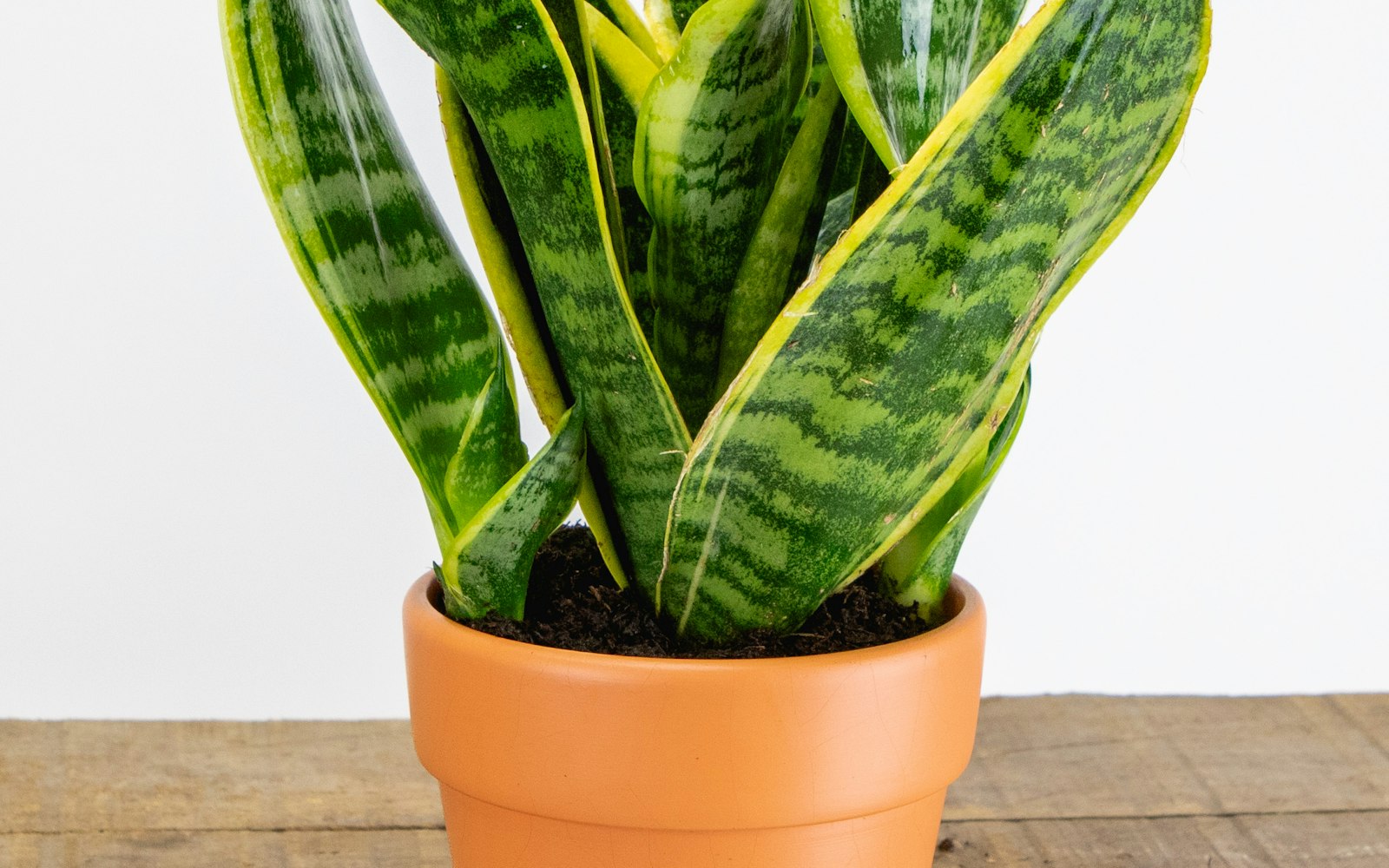
Snake plants used to be called Sansevieria; botanists now group them with Dracaena (the common one is Dracaena trifasciata). You'll still see both names in shops. Popular types include:
- Laurentii: the classic, with dark green banded leaves and yellow edges.
- Zeylanica: green and grey bands, no yellow edge.
- Moonshine: pale silvery-green leaves.
- Hahnii (bird's nest): short, wide leaves in a low rosette. Great for small shelves.
- Cylindrica: round, spear-like leaves, now often sold as Dracaena angolensis.
They all share the same care.
Light

Snake plants are famous for coping with low light, and they will survive in a dim hallway or office. But "survive" isn't "thrive". In low light they barely grow and use very little water, which makes overwatering more likely.
For a healthy plant that keeps putting out new leaves, give it bright, indirect light, such as near an east- or west-facing window. It can handle a few hours of direct sun once it is used to it, but move it into sun gradually; a plant moved straight from a dark corner into hot afternoon sun can scorch.
Watering: less than you think
This is where most snake plants are lost. The rules are simple:
- Wait until the soil is completely dry, not just the top. Push a finger or a wooden stick deep into the pot; it should come out dry.
- Then water thoroughly until water runs out of the drainage hole.
- Empty the saucer. Never leave the pot standing in water.
- Water much less in winter, sometimes only once a month or less in cool rooms.
As a rough guide, that is every 2–3 weeks in a warm, bright spot in summer and every 4–6 weeks in winter. In low light, stretch it even longer. When in doubt, wait a week.
Pour water onto the soil, not into the centre of the rosette. Water that sits between the leaves at the base can cause rot.
For more on reading the soil, see how often to water your plants.
Outdoors in the monsoon, keep the rain off. Snake plants on balconies and in courtyards across South Asia often rot in July and August, when the soil stays wet for days and the air is humid. Move pots under a roof overhang, tip out any water that collects in saucers or decorative pots, and stop watering completely until the mix dries out again.
In winter, outdoor plants in northern areas should come inside, or move against a warm wall, when nights drop below about 10°C.
Snake plants are watered much like succulents; our guide to succulent care mistakes explains the soak-and-dry method in detail.
Soil, pot and repotting
- Mix: a cactus or succulent mix is ideal. Or mix regular potting soil with about one-third perlite, pumice or coarse grit so it drains fast.
- Pot: always use a drainage hole. Terracotta is a good choice because it lets the soil dry faster. A heavy pot also stops tall plants tipping over.
- Repotting: snake plants like to be a little crowded, so repot only every 2–3 years, or when roots crack the pot or push the plant out. Go up just one size.
Best time to repot: spring or early summer, when the plant is growing and roots recover quickly. Avoid repotting in peak summer heat or in winter. After repotting or dividing, wait about a week before watering, so any broken roots can seal over instead of rotting.
A snake plant that has split or bulged its pot is ready for division at the same time. For step-by-step help, see how to repot a plant and our potting mix guide.
Feeding
Snake plants need very little food. Feed with a balanced houseplant fertiliser at half strength 2–3 times during spring and summer, and not at all in autumn and winter. Too much fertiliser does more harm than good.
How to propagate a snake plant
There are two easy ways:
1. Division (best and fastest). When you repot, you'll often find the plant has made new shoots, called pups, from underground stems. Gently separate a pup with some roots attached, using a clean knife if needed, and pot it in its own container. Water lightly and keep it out of strong sun for a couple of weeks.
2. Leaf cuttings (slow but fun).
- Cut a healthy leaf into pieces 5–8 cm long. Remember which end was the bottom; cuttings planted upside down won't root.
- Let the cut ends dry for 1–2 days so they seal.
- Push the bottom end 2 cm into slightly damp, gritty mix, or stand it in a little water.
- Keep warm and bright. Roots take about 4–8 weeks, and new pups can take a few months.
One catch: cuttings from yellow-edged varieties like Laurentii usually grow back without the yellow edge. To keep the edge, use division instead.
Common problems and fixes

| What you see | Most likely cause | What to do |
|---|---|---|
| Soft, mushy leaves, often yellow at the base | Overwatering, root rot | Stop watering; unpot and cut off black, mushy roots; repot in dry, gritty mix |
| Leaves falling over or bending | Overwatering or too little light | Check roots; move to brighter light |
| Wrinkled, thin, curling leaves | Underwatering (rare) | Water deeply; leaves should firm up in a few days |
| Brown, crispy tips | Irregular watering, salt build-up or a damaged tip | Water more evenly; flush the soil; trim tips with clean scissors |
| Pale, washed-out leaves | Too much harsh direct sun | Move to bright, indirect light |
| No new growth | Low light or winter rest | Normal in winter; give more light in spring |
| Brown, sunken spots | Cold damage or fungal spots from wet leaves | Keep above 10°C; water the soil, not the leaves |
If a leaf is badly damaged, cut it off at the soil line. It won't heal, but the plant will keep growing new ones. For yellowing in general, see why plant leaves turn yellow.
Do snake plants really purify the air?
You'll often read that snake plants "purify the air" or "release oxygen at night". Both come from real research, but the effect is much smaller than the headlines suggest. The famous NASA study was done in small, sealed chambers. In a normal home, you'd need a huge number of plants to make a measurable difference to air quality, and opening a window does far more. Snake plants do take in carbon dioxide at night, but the amount is tiny. Grow one because it is beautiful and easy, not as an air purifier.
Is it safe for pets?
Snake plants are mildly toxic to cats and dogs if chewed, and can cause drooling, nausea, vomiting or diarrhoea. Serious problems are rare, but keep the plant out of reach of pets that like to chew leaves, and call your vet if your pet eats a lot of it.
Looking for alternatives? Here are pet-safe houseplants you can grow instead.
Let GreenScan help
Not sure if your plant is a snake plant, a ZZ plant or something else? Scan it with the GreenScan Plant AI app to get its name and care basics. Add it to My Garden and set a long watering reminder, then check the soil before you water. If leaves turn soft or spotty, take a photo for a health check or ask Ask Botanist what to do.
FAQ
How often should I water a snake plant? Only when the soil is completely dry: usually every 2–3 weeks in summer and every 4–6 weeks in winter. In low light, less often.
Can a snake plant live in a room with no windows? It can survive for a while under bright artificial light, but it won't grow much. Give it a few weeks near a window from time to time, and water very sparingly.
Why is my snake plant falling over? Usually overwatering, which weakens the base of the leaves, or too little light, which makes leaves grow thin and floppy. Check the roots, let the soil dry, and move it to brighter light.
Do snake plants flower? Sometimes. Mature plants that are slightly root-bound and get good light may send up a stalk of small, fragrant, creamy flowers, usually in spring. It is a nice surprise but doesn't happen every year.
Should I cut off damaged leaves? Yes. Cut damaged or mushy leaves at the soil line with clean scissors. Brown tips can be trimmed, following the leaf's natural shape.
Sources and further reading
- Mother-in-Law's Tongue (Sansevieria trifasciata), ASPCA Animal Poison Control
- Dracaena trifasciata (Snake Plant), NC State Extension Gardener Plant Toolbox
- Potted plants do not improve indoor air quality: a review and analysis of reported VOC removal efficiencies (Cummings & Waring, 2019), Journal of Exposure Science & Environmental Epidemiology (Nature Portfolio)
Cover photo: Parker Sturdivant / Unsplash.